


The Unhappy Professional
Vicarious Trauma in Physicians
Medicine trains you to stay composed while other people experience their worst moments. You deliver diagnoses. You make decisions under pressure. You witness suffering you cannot always relieve. You carry outcomes that depended on your skill but were never fully in your control. From the outside it looks like expertise. Inside, it accumulates.
Your work places you at the intersection of fear, pain, grief, and urgency. You stabilize others while keeping your own reactions contained. That is the job. But the material does not always stay contained. A code that went badly. A patient's face when they understood the prognosis. A family's silence after you delivered the news. Even successful outcomes can carry a weight of their own.
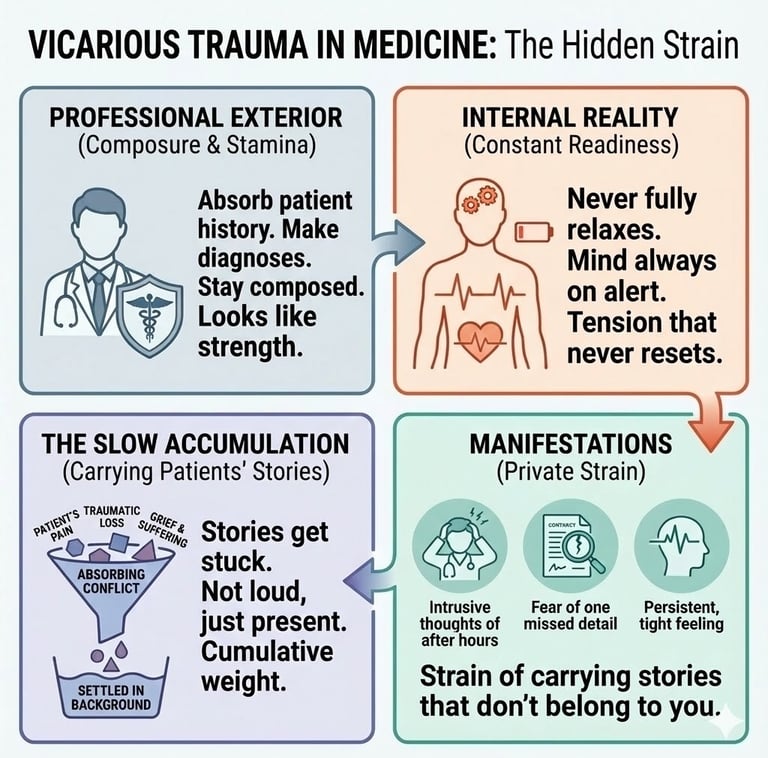
That slow accumulation is how vicarious trauma develops in medicine. It rarely announces itself. It shows up in how your system stays alert, the way your mind runs through scenarios after hours, and the way your body reacts when the next shift begins. No dramatic collapse, just tension that never fully resets.
Many physicians describe it privately in forms like these:
• Replaying a specific clinical moment at random times. A code. A delivery. A complication that unfolded too quickly.
• The faces or voices of patients who received devastating news, still vivid months or years later.
• Carrying the weight of outcomes you could not change, even when you did everything correctly.
This is the strain that builds when you absorb years of intensity that was never yours but lives in you anyway.
What Vicarious Trauma Does to a Medical Mind
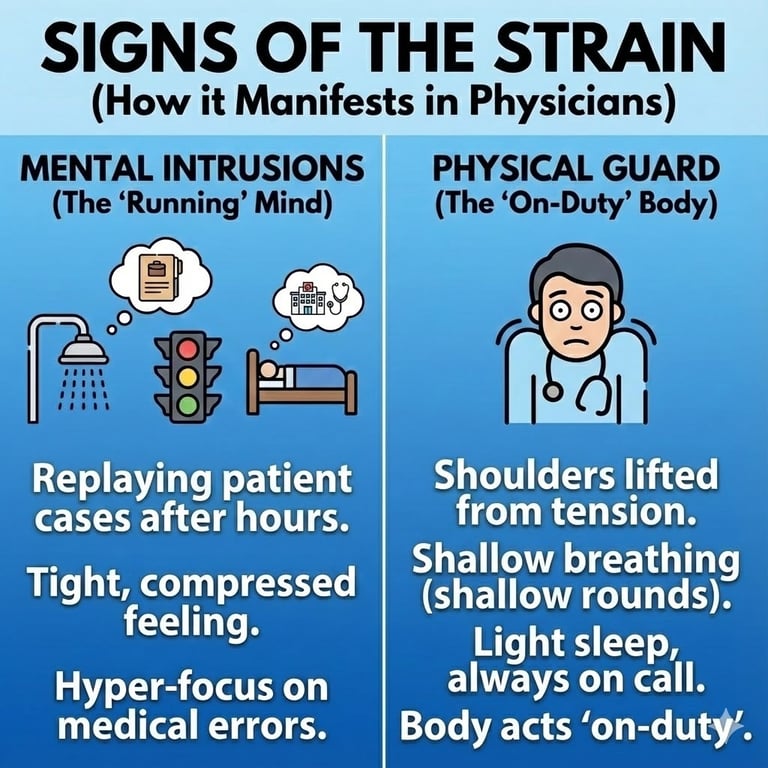
The medical mind relies on precision, speed, and the ability to hold multiple variables at once. That discipline is a strength. It is also what makes it easy to overlook the signs that something is wearing you down. Instead of feeling overwhelmed, you might feel numb, irritable, detached, or functioning but never quite rested. Some physicians notice they avoid certain types of cases or stay longer at work to delay the silence that arrives at home.
Over time, the body begins to act as if every shift is still active. Shoulders stay lifted. Sleep runs lighter. The mind stays in problem-solving mode even when there is no immediate problem. You remain competent but never fully off duty.
This does not mean you are burned out. It means you have been exposed to years of suffering, uncertainty, life-and-death responsibility, and the emotional residue of witnessing pain you could not take away. This is how vicarious trauma typically appears for physicians. It is steady, cumulative, and rarely discussed.
Many physicians assume therapy will make them less sharp or more emotional. The truth is more precise. Therapy restores your capacity to feel without being paralyzed by what you feel. You likely numbed parts of yourself to keep functioning. That worked for a time. But sustained numbness comes with a cost. Therapy helps you process what you have absorbed so your system can return to a steadier baseline. You will also feel more peaceful, clearer, and more effective because you are no longer relying on a chronically activated nervous system to hold everything at bay.
My work with physicians usually develops in two tracks.
Psychodynamic Work
Something in you was drawn to this work long before you understood its cost. Maybe you needed to be the one who fixes things. Maybe you carried responsibility early. Maybe you learned that your value came from being capable, steady, needed. Maybe you were trying to make sense of loss, illness, or powerlessness you witnessed growing up. Whatever it was, it shaped you into someone who could tolerate what most people cannot.
Medicine did not create these patterns. It amplified them. The drive to save, to solve, to bear what others cannot bear - that existed in you before the white coat. Psychodynamic work examines those deeper structures. Why you carry what you carry. Why outcomes feel personal even when they are not. Why rest feels impossible. Why you absorbed the role so completely that you no longer know where the physician ends and you begin.
Once these unconscious dynamics move into awareness, they do not disappear. The drive to heal, to solve, to carry what others cannot carry, these are real parts of who you are. They brought you to medicine for a reason. Psychodynamic work does not strip you of these qualities. It helps you understand them deeply enough that you can live them consciously rather than being unconsciously driven by them. You remain the physician you were meant to be. You simply stop paying the invisible cost of carrying burdens that were never yours to solve.
EMDR
EMDR is useful when the body keeps replaying moments you wish it would release. A code that sits in your chest. A patient you still think about during quiet hours. The moment a family's hope changed. EMDR helps the body file those moments so they no longer activate your system in the background.
The work stays clear, structured, and efficient. It simply restores the capacity to rest once the shift is done.
Why Therapy Helps Without Slowing You Down
Unique Therapy Offering
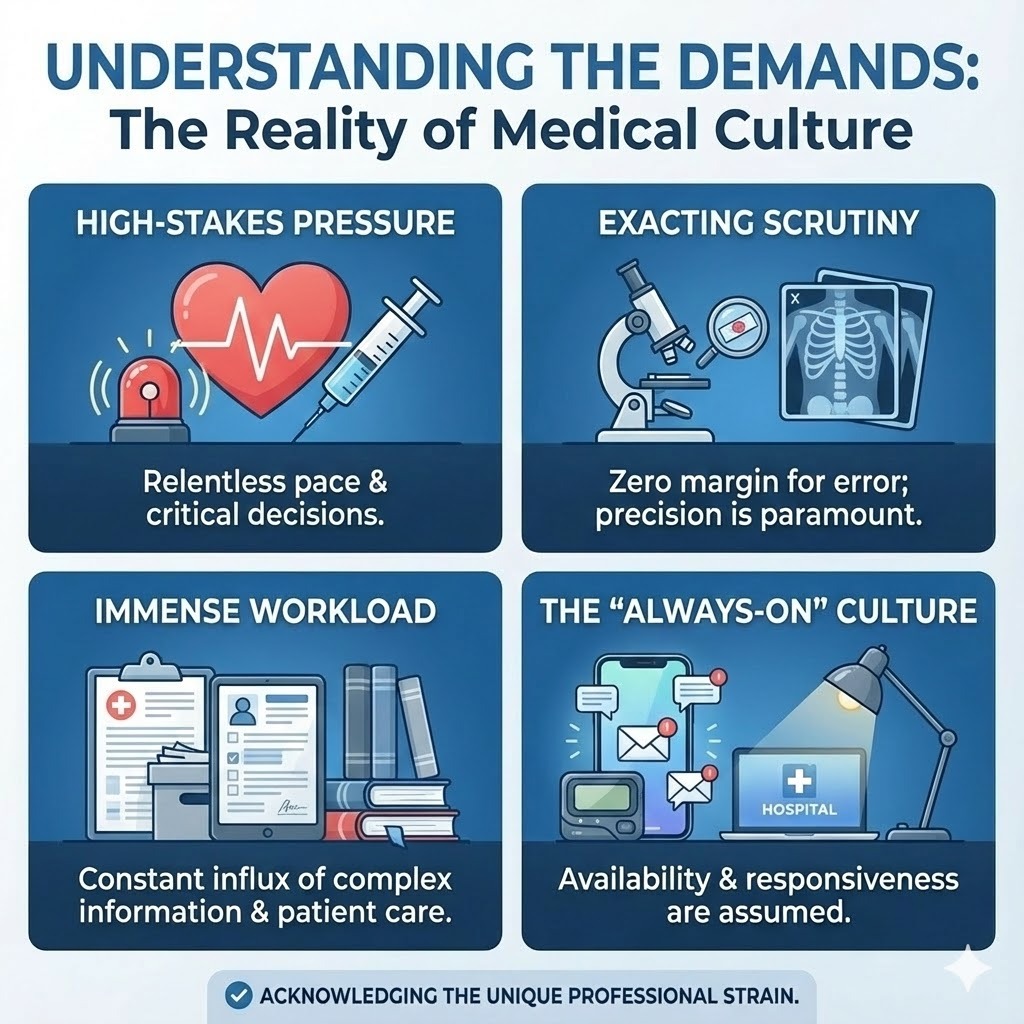
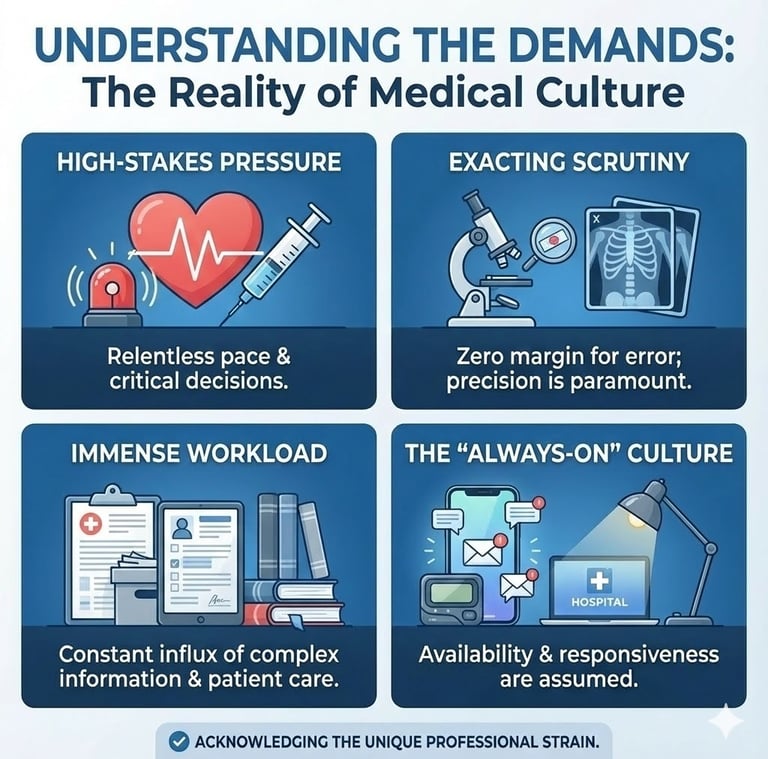
You will not need to explain the culture of medicine, the tension between patient care and administrative demands, or why taking time off is not realistic. I understand the internal rules of this profession and the psychological toll that comes with them. The pace, the stakes, the expectation of composure, and the requirement to keep moving all create a unique strain.
If you are reading this, you may have noticed a subtle shift. Not a collapse. Not a crisis. Just a sense that your system is carrying more than it used to.
If you want to talk, you can schedule a consultation directly with me. We can look at what you have been holding, how your body has adapted, and how to restore a stable baseline without compromising the qualities that make you effective.
Whenever you are ready, reach out. You do not have to keep carrying the clinical weight alone.
I understand first hand how difficult it can be to carry the weight of unresolved emotional pain. My diverse personal and professional experiences have given me a deep appreciation for how unique each individual’s journey is.
Whether it’s healing from childhood trauma, navigating relationship difficulties, or overcoming professional stress, I’m here to help you find the peace and fulfillment you deserve.
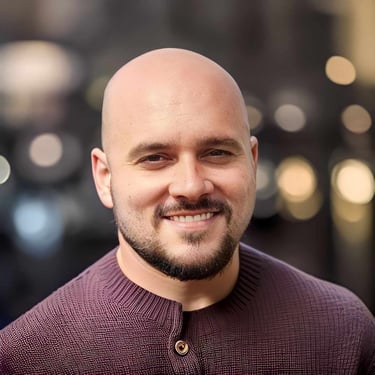
Zack Rothwell, PMHNP
Psychiatric Health Nurse Practitioner
Master of Science - UNC Chapel Hill
Accepting New Clients
1530 Wilson Blvd Suite 100-105, Arlington, VA 22209
Helping leaders find joy and purpose in life.
© 2025. All rights reserved.
Online Therapy in: CO, DC, NC, NY, TX, VA, WA & WV