


The Unhappy Professional
Vicarious Trauma in the Legal Profession
Most lawyers learn early that composure is part of the job. You absorb facts, hold competing stories in your head, follow the rules, stay sharp, and keep your footing even when a case pulls in several directions at once. From the outside it looks like stamina. Inside, it feels like constant readiness that never fully relaxes.
The law places you in the middle of other people's conflict. Sometimes their losses. Sometimes their worst impulses. You are trained to organize it, argue it, and move forward. But the material does not always move forward. Certain cases settle in the background. Not loudly. Just present. A client who was blindsided by a ruling. A family unraveling during litigation. A person whose future depended on your precision. Even a clear win can carry a weight of its own.
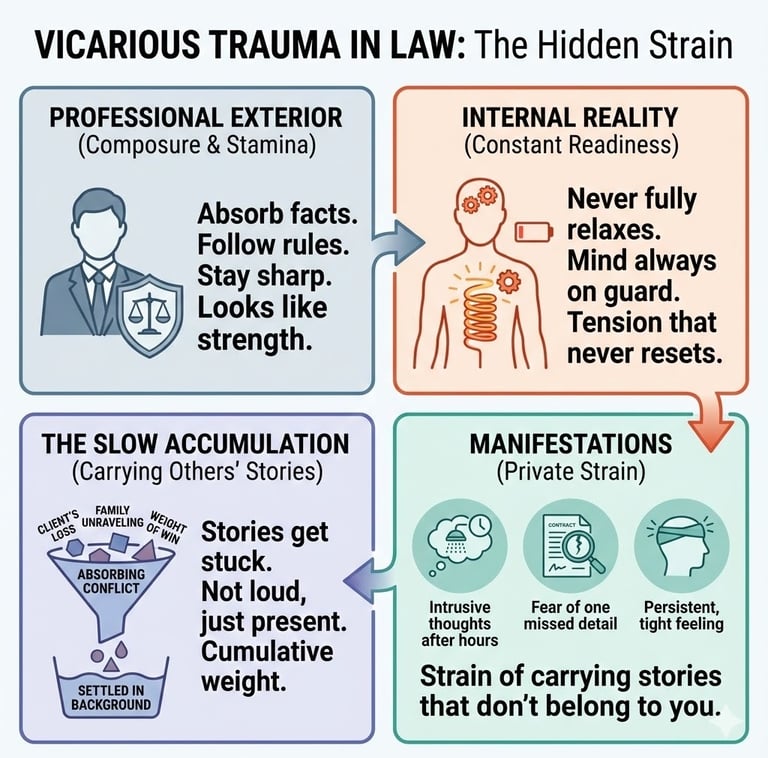
That slow accumulation is how vicarious trauma often develops in this field. It rarely announces itself. It shows up in a shift in how your mind stays on guard, the way your thoughts continue running after hours, and the way your body feels when the next task arrives. No dramatic spikes, just tension that never resets.
Many lawyers describe it privately in forms like these:
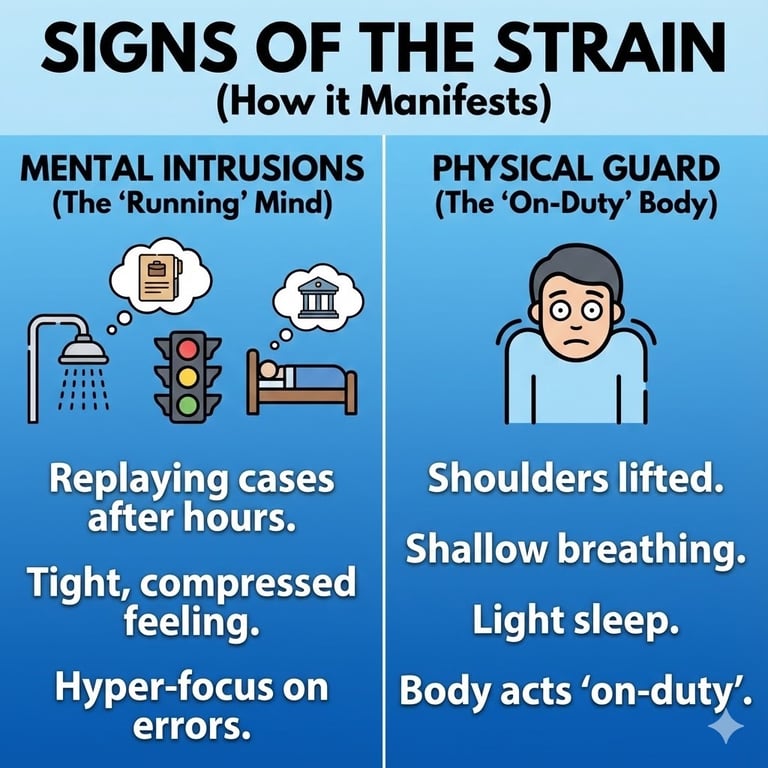
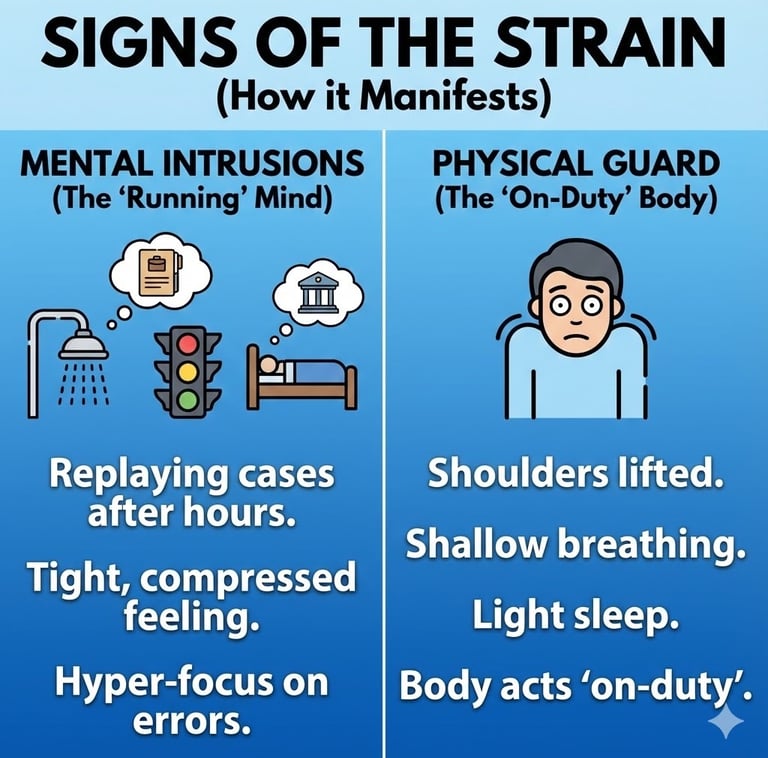
• Mentally reviewing case details at stoplights, in the shower, during conversations with people you care about.
• The certainty that one missed precedent, one overlooked clause, could cost someone everything.
• A tight, compressed feeling in the mind that stays even when nothing urgent is happening.
Vicarious trauma is one part of the broader emotional cost of this profession. Read The Hidden Emotional Toll of Practicing Law.
It is the strain that builds when you carry too many stories that do not belong to you but still live inside you.
What Vicarious Trauma Does to a Rule-Driven Mind
The legal mind relies on order, structure, and a clean path from premise to conclusion. That discipline is a strength. Yet it is also the same discipline that can make it easy to overlook the signs that something is wearing you down. Instead of feeling overwhelmed, you might feel tense, irritable, detached, or sharper than usual in ways that do not feel good. Some lawyers notice they work more than necessary to avoid the mental static that arrives during downtime.
Over time, the body begins to act as if every case is still open. Shoulders stay lifted. Breathing stays shallow. Sleep runs lighter. You remain capable but never fully off duty.
This does not mean you are burned out. It means you have been exposed to years of conflict, grief, accusation, pressure, and the weight of being the one responsible for a result when your actual control was limited. This is how vicarious trauma typically appears for lawyers. It is steady, cumulative, and rarely acknowledged.
Many lawyers assume therapy will make them less sharp or more emotional. That is not the outcome. Therapy gives you a private place to sort through what you have absorbed so your mind can return to a cleaner, steadier rhythm. The goal is not to soften you. The goal is to allow you to be effective without relying on a stressed nervous system.
My work with lawyers usually develops in two tracks.
Psychodynamic Work
Psychodynamic therapy for vicarious trauma examines why the exposure affected you the way it did.
You already know what happened in the cases. You know what you witnessed, what you read, what your clients described. Psychodynamic therapy does not relitigate the content. It examines why certain material lodged in you when other material didn't. Why some cases follow you home. Why you carry your clients' crises as if they were yours to solve.
Vicarious trauma is present-day trauma. You witnessed real harm. You absorbed real suffering. The cases were genuinely difficult, the exposure genuinely destabilizing. Psychodynamic therapy does not minimize that. But it examines why your system could not discharge it. Why the material stayed active instead of resolving. Why rest stopped working. Why professional distance collapsed even though you knew how to maintain it.
The work clarifies how you organized the threat. Why certain defenses that once protected you now trap the trauma inside. Why hypervigilance feels safer than rest. Why you brace for disaster even in situations unrelated to your practice. Psychodynamic therapy makes these patterns visible so you can work with them deliberately instead of being driven by them unconsciously.
Once you understand how you have been carrying the trauma - not just what you carry, but how and why - the structure begins to shift. You develop the capacity to process what you could not process before. You remain capable of holding difficult material. You simply stop organizing your entire nervous system around preventing an outcome you cannot control.
EMDR Therapy
EMDR is useful when the body keeps replaying moments you wish it would release. These are not always traumatic moments in the classic sense. They can be hearings that went sideways, a client's reaction that still flickers in memory, or a specific detail that returns in quiet moments. EMDR helps the body file those moments so they no longer activate your system in the background.
The work stays clear, structured, and efficient. It simply restores the capacity to rest once the workday is done.
To learn more about working together read Therapy For Lawyers
Why Therapy Helps Without Slowing You Down
Unique Therapy Offering
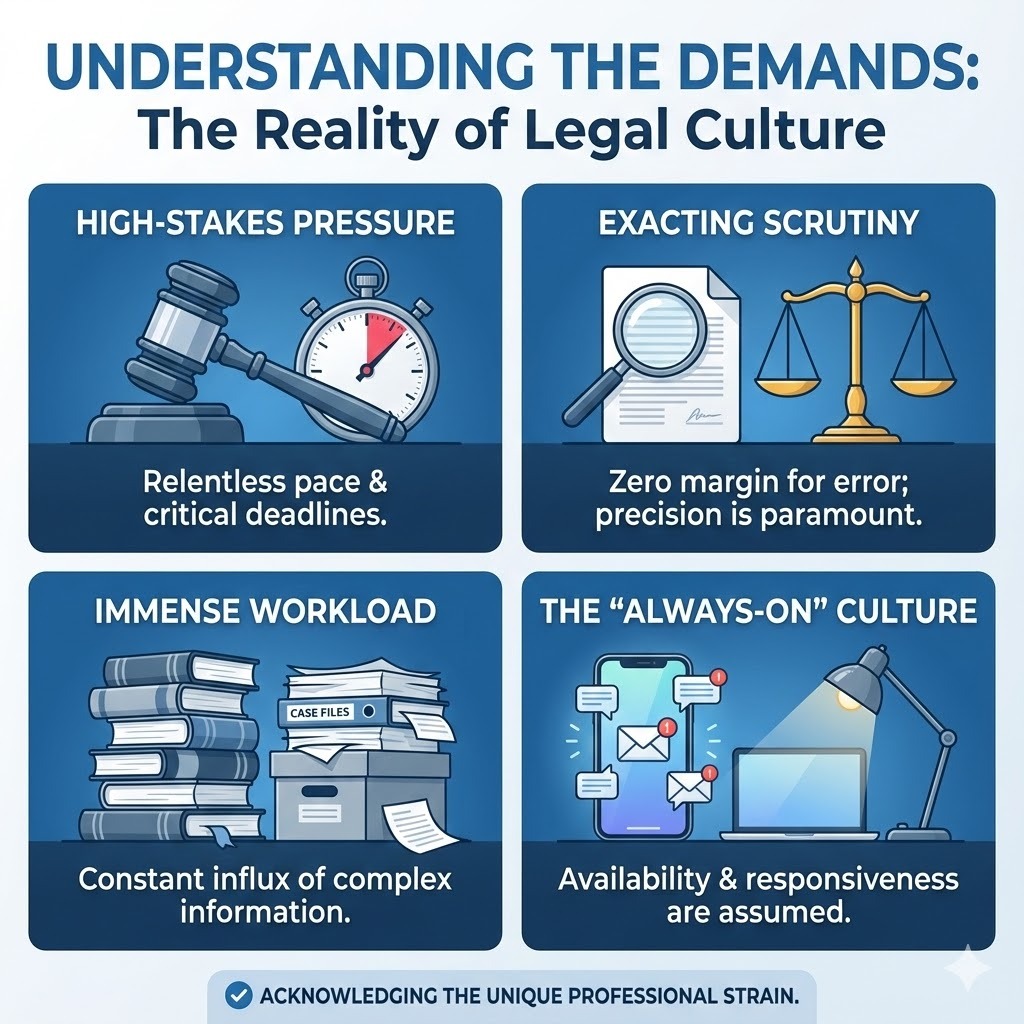
You will not need to explain courtroom culture, firm hierarchy, billing pressure, or why taking a break is not a realistic plan in your world. I understand the internal rules of this profession along with the psychological toll that comes with them. The pace, the scrutiny, the expectation of accuracy, and the requirement to stay composed all create a unique strain.
If you are reading this, you may have noticed a subtle shift. Not a collapse. Not a crisis. Just a sense that your system is carrying more than it used to.
If you want to talk, you can schedule a consultation directly with me. We can look at what you have been holding, how your body has adapted, and how to restore a stable baseline without compromising the qualities that make you effective.
Whenever you are ready, reach out. You do not have to keep absorbing everything alone.
I understand first hand how difficult it can be to carry the weight of unresolved emotional pain. My diverse personal and professional experiences have given me a deep appreciation for how unique each individual’s journey is.
Whether it’s healing from childhood trauma, navigating relationship difficulties, or overcoming professional stress, I’m here to help you find the peace and fulfillment you deserve.


Zack Rothwell, PMHNP
Psychiatric Health Nurse Practitioner
Master of Science - UNC Chapel Hill
Accepting New Clients
1530 Wilson Blvd Suite 100-105, Arlington, VA 22209
Helping leaders find joy and purpose in life.
© 2025. All rights reserved.
Online Therapy in: CO, DC, NC, NY, TX, VA, WA & WV